From Home Kitchen to Store Shelf
A food product can outgrow a home kitchen long before the business is ready to scale.

September 15, 2026
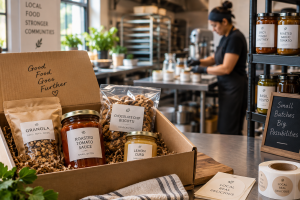
Small food brands often move from recipe testing to licensed production before they are ready for larger retail or wholesale orders.
The shift usually starts quietly. One oven stops being enough. Ingredients spill beyond the pantry. Containers, labels, and delivery boxes begin taking over the house. Then a retailer asks where the product is made, or a farmers market wants proof of insurance.
That is often the point when a food business stops being a side operation and starts becoming a commercial one.
A recipe that works for friends, neighbors, and occasional orders now has to work for buyers who expect more than good taste. Retailers, markets, cafes, and wholesale accounts want consistency. They need to know the product is made legally, labeled correctly, delivered on time, and produced the same way from one order to the next.
That brings a different set of questions. Is the food produced in a licensed kitchen? What allergens are present? How is it stored? Does the label meet the requirements for that product category? Is the business insured? Can production increase without sacrificing quality?
A home kitchen is a useful place to begin. It is where recipes are tested, prices are worked out, and early customers provide feedback. But selling at retail introduces pressures that home production is not always built to handle. Packaging has to survive transport and display. Labels have to be accurate. Larger batches have to taste the same as smaller ones. Orders have to be completed on the buyer’s schedule, not whenever there happens to be time.
For many small food businesses, a shared commercial kitchen becomes the practical bridge between home production and a fully retail-ready operation. It provides access to commercial equipment, prep space, refrigeration, storage, and a licensed production environment without requiring the cost of building and maintaining a private facility.
That becomes especially important once orders begin to grow. A single shop may start with a small opening order. A successful market weekend can create more demand than expected. A holiday season can expose weak production systems almost immediately. The real test is not whether a product can be made once. It is whether it can be made repeatedly, safely, consistently, and on schedule.
Before approaching buyers, producers should be able to answer a few basic questions with confidence. Where is the product made? How much can be produced at one time? What information must appear on the label? How will the product be stored and delivered? What insurance is required? Does the recipe still work at a larger scale? If the first order sells through quickly, can the next one be filled just as reliably?
Getting onto a shelf is only the beginning. Staying there is harder.
A retailer may take a chance on a local product because it tastes good, looks distinctive, or has a compelling story. Reorders usually depend on less glamorous things: consistency, packaging, communication, timing, and the ability to deliver without problems.
Cook & Bake Center gives local food entrepreneurs a place to make that transition. Bakers, caterers, packaged-food producers, and specialty food businesses can use commercial kitchen space as they prepare for farmers markets, wholesale accounts, retail shelves, and larger customers.
For most small food brands, the move from home kitchen to store shelf happens in stages. Refine the recipe. Improve the packaging. Move production into a licensed space. Sell locally. Listen to buyers. Strengthen the process. Then scale.
A good product may earn the first order. A dependable operation is what earns the next one.